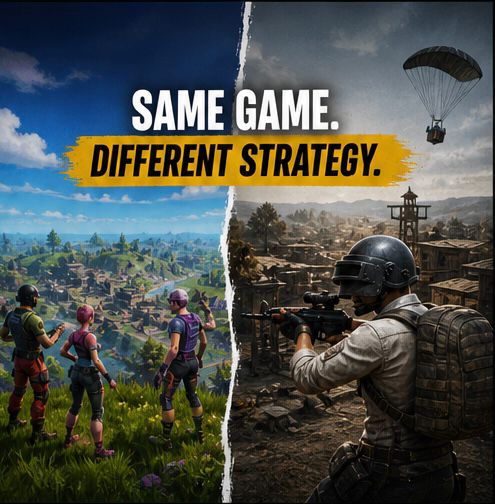
The Company That Creates the Market Is Rarely the One That Wins It
A deep strategy analysis of how Fortnite crushed PUBG — and what every business can learn from it.
There’s a brutal truth hiding inside every startup success story: being first doesn’t mean being last. The company that educates the market, takes the early risk, and absorbs the learning curve — often hands the keys to a smarter, better-resourced competitor who shows up just a little later.
PUBG built the battlefield. Fortnite won the war.
This is not just a gaming story. It’s a masterclass in competitive strategy, distribution economics, and ecosystem thinking. And the lessons cut far beyond gaming — into agriculture, D2C brands, fintech, and every market where a fast-follower has ever outrun a pioneer.
Part 1: The Rise of the First Mover — PUBG’s Brilliant Beginning
In early 2017, Brendan “PlayerUnknown” Greene launched PUBG into Steam Early Access. The game was raw, buggy, and technically imperfect. It didn’t matter. It generated $11 million in revenue within 3 days. One million copies sold in a month. Four million by June. It became the fastest-selling game on Steam at the time.
PUBG had what every strategist dreams of: genuine product-market fit before the product was even finished.
Krafton (then Bluehole) stumbled onto something profound — the Battle Royale format tapped a suppressed desire. Players wanted tension, consequence, and survival. PUBG delivered all three in ways that felt visceral and real. The realistic graphics, mil-sim aesthetic, and unforgiving gameplay created a niche audience with unusually high engagement.
From a BCG Matrix perspective, PUBG was a pure Star — high market growth, dominant market share. From a SWOT lens, its strengths were clear: first-mover positioning, authentic brand, and a deeply loyal core audience. The business model was straightforward: premium pricing, high margins, global distribution through Steam.
But embedded in that very success were the seeds of vulnerability.
Krafton’s business model canvas revealed a narrow customer segment — predominantly hardcore PC gamers. Its revenue streams were largely one-time purchase-based. Its key partnerships were limited. And critically, the company’s innovation speed was governed by engineering perfectionism rather than market responsiveness. PUBG was a product. It hadn’t yet become a platform.
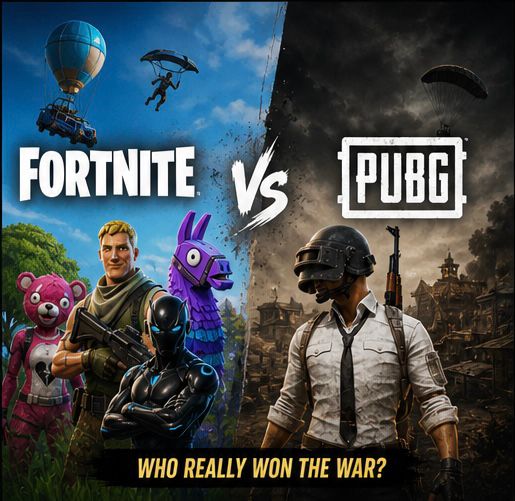
Part 2: The Entry of the Giant — How Epic Games Changed the Rules
In September 2017, Epic Games launched Fortnite Battle Royale. The mode was built in two months, repurposing assets from their existing Save the World title, after recognizing the viral momentum PUBG had created.
Let that sink in: Fortnite Battle Royale was developed in 60 days. And it went on to register hundreds of millions of players.
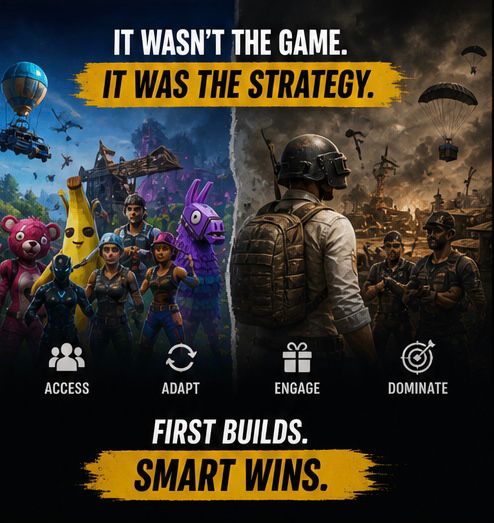
Epic’s genius wasn’t the game. It was the strategy layered around it.
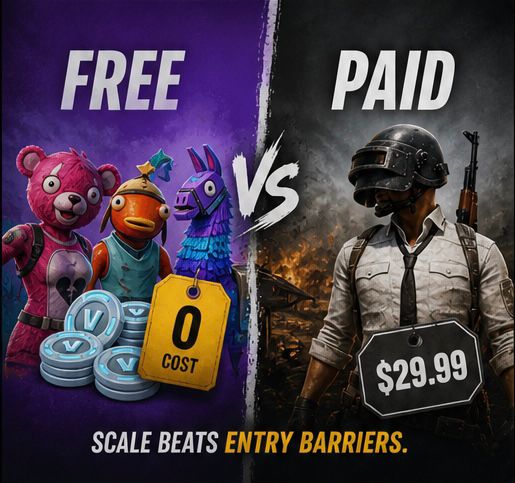
Free-to-play. This single decision rewrote the competitive calculus entirely. While PUBG charged ~$30, Fortnite charged nothing. The barrier to entry dropped to zero. Suddenly, every teenager with a console, every casual gamer, every parent letting their kid try something new — all became potential players. Epic’s Porter’s Five Forces analysis shows how this neutralized buyer power and obliterated substitute threat simultaneously. When your product is free, switching costs are psychological, not financial.
Cross-platform dominance. Fortnite launched on PC, PlayStation, Xbox, iOS, Android, and Nintendo Switch. PUBG remained primarily PC-centric in its early, dominant phase. Epic’s marketing mix was built around radical accessibility — reach every screen, own every living room, appear in every device category. The platform itself became the moat.
Influencer-led distribution. Epic didn’t spend conventionally on advertising. They understood that in 2017, the most powerful distribution channel for gaming was Twitch and YouTube. Top streamers like Ninja (who hit 600,000 concurrent viewers in a single stream) became de facto brand ambassadors. The game’s colorful, expressive aesthetic made it ideal for streaming — it was watchable in ways PUBG’s muted realism was not. Fortnite optimized for entertainment, not just gameplay.
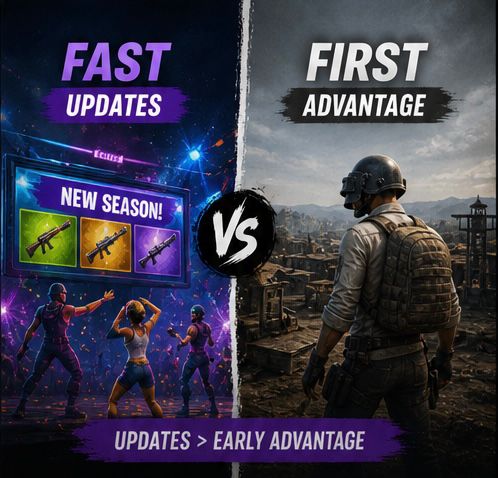
Content velocity as competitive weapon. Fortnite released over 200 updates in its first year. Every week brought new weapons, modes, map changes, and limited-time events. The game never felt stale. It manufactured FOMO at industrial scale. Epic’s live-service model transformed the game from a product into a perpetual experience — always new, always surprising.
Part 3: The Five Principles That Crushed the Incumbent
When you strip away the specifics, five strategic principles explain how Fortnite dominated:
1. Free beats better. PUBG was the better game by hardcore gaming standards — more realistic, more technically refined. It didn’t matter. Free eliminates the consideration stage entirely. Customers don’t evaluate what they never have to pay for.
2. Distribution beats product. Epic’s Unreal Engine relationships, console partnerships, and platform deals gave Fortnite distribution reach that no pure-play game studio could match. PUBG had a great product. Epic had infrastructure.
3. Content velocity beats innovation. PUBG innovated in depth — updates were meaningful but infrequent. Epic innovated in surface area — smaller but relentless changes that kept the cultural conversation alive. In attention economies, presence beats perfection.
4. Ecosystem beats single product. Epic Games wasn’t just making a game. They were building a platform. The Epic Games Store, V-Bucks, cross-title asset usage, and the Unreal Engine created compounding value that PUBG’s standalone title never could.
5. Marketing leverage beats early advantage. Fortnite’s cultural collaborations — with Marvel, Star Wars, Travis Scott, Ariana Grande — transformed the game into a cultural event. These weren’t marketing tactics. They were ecosystem expansions that continuously attracted new audiences.
Part 4: Deep Strategic Comparison
| Dimension | Epic Games (Fortnite) | Krafton (PUBG) |
|---|---|---|
| Business Model | Platform + ecosystem; free-to-play with cosmetic monetization | Premium game sale + battle pass (added later) |
| Monetization | V-Bucks, Battle Pass, cosmetics — recurring, high-margin | One-time purchase; later moved to free-to-play |
| Distribution | All platforms, all devices, zero barrier | PC-first, console late entry |
| Innovation Speed | 200+ updates in Year 1; weekly content drops | Deep but infrequent; engineering-driven cycles |
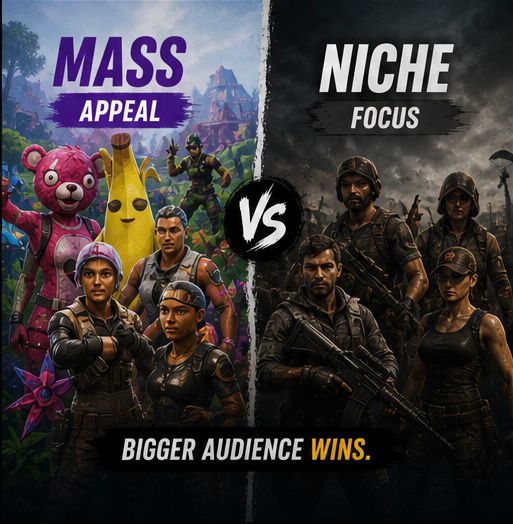
| Customer Strategy | Mass market — casual to competitive, ages 10–35 | Hardcore gaming segment; older, PC-native demographic |
| Cultural Presence | Collabs with Marvel, NFL, musicians; Fortnite as cultural event | Esports-focused; credibility over celebrity |
| Strategic Moat | Network effects + ecosystem lock-in | Product depth + brand authenticity |
Part 5: Where the Incumbent Was Still Strong
Let’s be honest about something: PUBG didn’t die. It adapted.
Krafton eventually went free-to-play, expanded to mobile through PUBG Mobile (which became a massive hit in Southeast Asia and India), and built a loyal audience that valued what Fortnite deliberately avoided — tactical realism, mil-sim credibility, and competitive depth.
PUBG’s strengths in product authenticity and niche positioning proved durable. Its mobile expansion showed genuine strategic flexibility. Krafton’s SWOT analysis reveals a company with real depth in IP management, emerging market penetration, and a player base that trusts the product.
The lesson: niche loyalty is a real asset. Not every market wants the mainstream answer. PUBG’s audience wanted something Fortnite couldn’t give them. The mistake would have been chasing Fortnite’s audience entirely — abandoning authenticity for scale.
Part 6: What Giants Can Learn From Underdogs
Big players often forget what made them dangerous before they became dominant.
Speed and agility. PUBG shipped a minimum viable game and let the audience shape it. This is startup instinct — move fast, validate fast, iterate fast. Giants like Epic, flush with capital, can lose this reflex. They over-engineer. They over-plan. The smaller player’s willingness to ship imperfect things at speed is a genuine competitive advantage.
Focused positioning. PUBG knew its customer. Hardcore. Tactical. Serious. That focus created fierce loyalty. Mass-market players often sacrifice depth for breadth and end up meaning nothing to anyone.
Authentic engagement. PUBG’s community felt heard in ways that corporate juggernauts rarely replicate. Community-driven development — where players genuinely shaped the roadmap — created an emotional bond that scale destroys.
Part 7: What Underdogs Must Learn From Giants
And yet, the data is clear: ecosystem thinking wins markets.
Network effects are non-negotiable. Fortnite’s value increased with every player that joined. PUBG’s did not scale in the same way. Building for network effects — where your product becomes more valuable as more people use it — is a deliberate architectural choice, not an accident.
Platform over product. The most durable businesses in gaming (and beyond) are those that become platforms where others build value. Epic’s ecosystem — the Store, Unreal Engine, creator economy — compounds over time. A single game, no matter how brilliant, remains a single point of failure.
Marketing as strategy, not support. Epic treated marketing as a core strategic function, not a support activity. Influencer partnerships, cultural collaborations, and seasonal events were as important to growth as the engineering team. Small players often underinvest in this — and pay the price.
Part 8: Industry-Level Signals
The PUBG-Fortnite story is a microcosm of three macro-shifts reshaping every industry:
From product to experience. Players don’t buy games anymore — they inhabit worlds. Customers don’t buy products — they join communities. The experience layer has become the primary value driver.
The rise of live-service economics. Subscription and live-service models generate recurring revenue, compounding engagement, and continuous data feedback loops. One-time transactions are structurally inferior. This shift is happening in agriculture (precision farming subscriptions), fitness (Peloton, Mirror), and software everywhere.
Platformization is the endgame. Every category eventually produces one or two platform winners who capture disproportionate value. Identifying whether you are building a platform or a product — and choosing deliberately — may be the most important strategic decision a company makes.
Part 9: Three Original Strategy Frameworks
🔁 The Gaming Domination Loop
Free Entry → Mass Adoption → Network Effects → Cultural Relevance → Monetization at Scale → Reinvestment in Content → Return to Free Entry
This is the flywheel Epic mastered. The insight: monetization comes after dominance, not before. Remove friction first. Capture attention second. Convert third.
⚙️ The Free-to-Scale Flywheel
Price = $0 → Addressable market explodes → Distribution advantages compound → Data advantages emerge → Personalization improves → Retention increases → ARPU grows through optional spending
Free doesn’t mean unprofitable. It means patience. The companies that can finance the patient zero-revenue phase to achieve critical mass win disproportionately.
🔒 The Ecosystem Lock-In Model
Content → Community → Currency → Creator Economy → Platform Dependency
Fortnite didn’t just create a game. It created V-Bucks (currency), a creator program, a live events calendar, and cross-IP collaborations. Each layer made leaving harder. Each layer added users who would never have joined for the base game alone. This is the architecture of durable competitive advantage.
Part 10: Beyond Gaming — Lessons for Every Business
For startups: Your first-mover advantage is real but fragile. Use it to learn, not to relax. Build for network effects from day one, not as an afterthought.
For agricultural businesses: The shift from selling crops to selling data, advisory services, and precision platforms mirrors the product-to-ecosystem shift in gaming. The farmer who sells yield is replaceable. The platform that owns the data relationship is not.
For D2C brands: Community is your moat. A loyal, niche audience that trusts your brand is more valuable than 10x the customers who feel nothing. Don’t chase mass market at the cost of meaning.
For tech platforms: Free tiers, developer ecosystems, and API strategies are the gaming industry’s playbook applied to enterprise. Give away the base. Monetize the depth.
Conclusion: The Speed of Evolution Is the New Competitive Advantage
PUBG created the category. Fortnite owned it.
The story isn’t about who had the better game. It’s about who had the better model, the better distribution, and the better understanding of how modern attention economies work.
In every market — gaming, agriculture, fintech, media — the winner is increasingly not the one who builds first, but the one who evolves fastest, distributes broadest, and locks in deepest.
First-mover advantage gives you a head start. Ecosystem thinking gives you a finish line the competition can’t find.
Build your product. Then build the world around it.
Written in the tradition of strategy-first storytelling. If this sparked a thought, challenge it, share it, or apply it — that’s what good frameworks are for.
 STRATΞLLI